
Main/Forest Pedestrian Safety
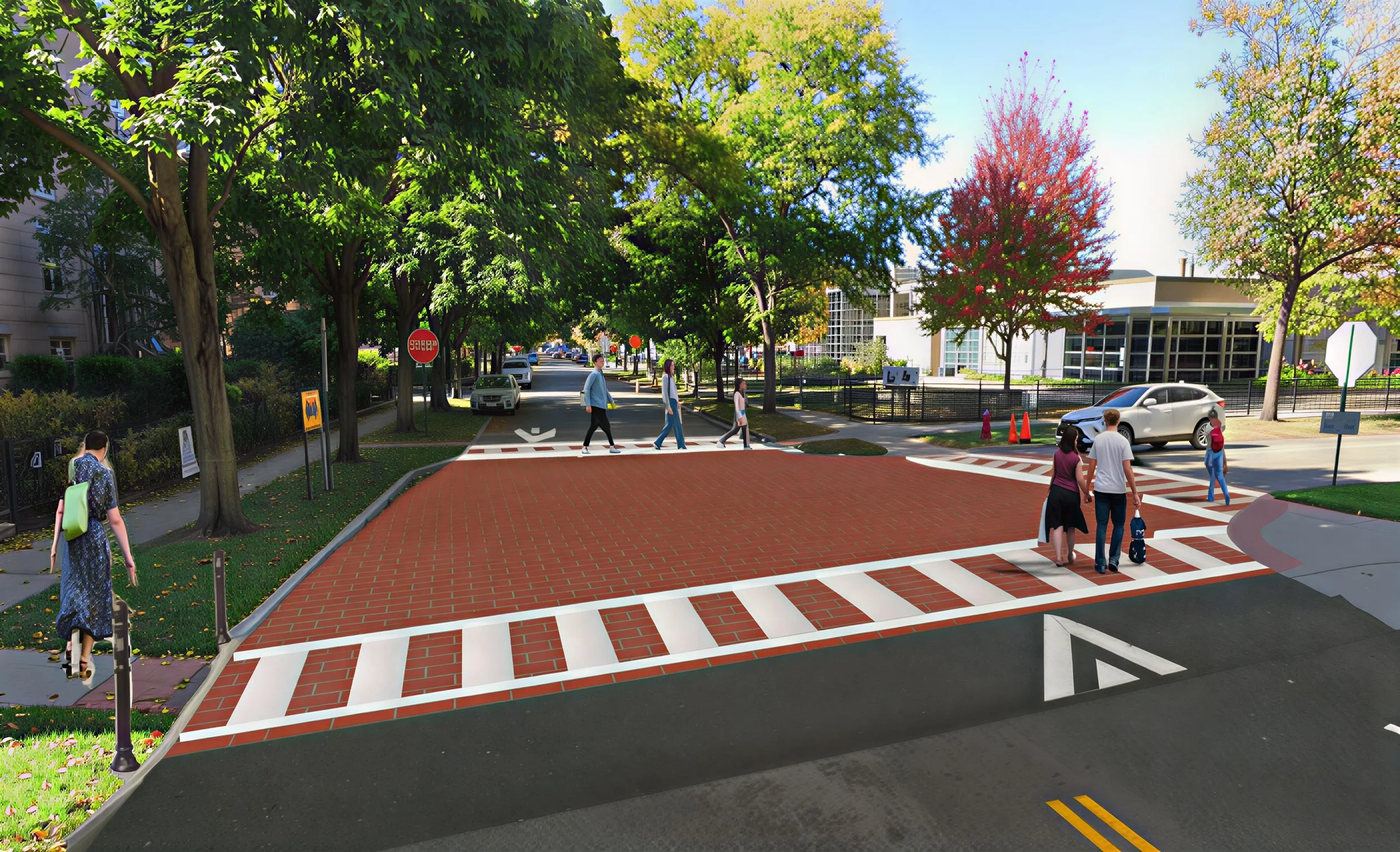
Vision of what a raised intersection could look like outside of Lincoln School.
A group of residents who live near Lincoln School are advocating for a change to the existing design of intersections at Main Street & Forest Avenue and Main Street & Michigan Avenue in the Third Ward to prioritize protecting pedestrians and cyclists and deter unsafe driving.
Current best practices for pedestrian and traffic calming infrastructure include:
Raised crosswalks, which are speed humps with a crosswalk that extend across a road at sidewalk level, providing a physical element to slow drivers while increasing pedestrian visibility, and…
Raised intersections, which are similar but extend across the entire intersection, slowing drivers on each approach.
These improvements, along with better focused street lighting at crosswalks, are needed in our community to improve safety, especially considering the history of numerous severe incidents involving cars and pedestrians along these streets.
Raised crosswalks/ intersections at Main & Forest and Main & Michigan meet all criteria listed in the Illinois Department of Transportation Bicycle and Pedestrian Accommodations Standards and are consistent with Evanston’s Complete Streets and Vision Zero policies, as well as our Climate Action and Resilience Plan.
There is also local precedent, with a raised crosswalk recently installed on Main between Sherman and Custer, which has identical street characteristics including average daily traffic volumes.
I was walking my dog on a dark morning and saw lots of police with a helicopter hovering above. An elderly neighbor was hit by a car crossing Main Street and died from his injuries. It was very sad, and I’ll always wonder if better lighting would have prevented his death.
-- Joe H.
It was 5:30 at night and I was hit by a car crossing Main Street with my dog at Forest; an SUV ran the stop sign. Both my dog and I ended up badly bruised. The police met me in the hospital emergency room and are looking for the hit-and-run driver.
-- Jen M.
In 2023 as I crossed Main Street at the Main/Forest intersection a car came speeding westward from Sheridan right toward me. At the same time, a car had turned eastward on Main at the Main/Forest intersection and sped toward me. My foot got stuck, I went flying, landed on my shoulder and broke it. It took me 8 months to recover. I don't know what it will take to get people to drive more responsibly on that stretch of road, but something really needs to be done.
-- Melissa M.
My husband was walking our dog when a car came zooming down Forest and turned east on Main Street and hit him. He went flying over the hood of the car. Luckily, he was not seriously injured! The driver was very shaken; he did not see anyone crossing the street.
-- Judy P.
I live on the south side of Main Street, and both my kids go to Lincoln. I always worry about them crossing Main when the school crossing guards are not on duty, especially when it is dark outside. It’s a preventable tragedy waiting to happen.
-- Ryan H.
I am always afraid to cross the street at Forest and Main, especially when it is dark outside. Cars are so focused on turning onto Main Street, they simply don’t notice the pedestrians.
-- Paul C.
I witnessed a car that went directly through the stop sign on Forest hitting a tree on Main Street. Luckily no children were around! This intersection is so dangerous.
-- Kelley H.
I have had two close calls at the corner of Main and Forest. Once I had to jump forward to avoid being hit by a car. The second time, I was in the crosswalk and saw a car speeding toward me. I put out my hand and the car screeched to a halt just a foot from me.
-- Janet K.
Fill out this form to “sign” in support of the installation of raised crosswalks, raised intersections and better lighting at the corners of Main & Forest and Main & Michigan in Evanston’s 3rd Ward.
Frequently Asked Questions
Will the existing intersection drainage/ice-build up issues be worsened with these changes?
No, the construction of a raised intersection would require modification to the Main/Forest intersection including existing drainage (or lack thereof). Therefore, a raised intersection would actually be the best way to resolve existing ice build-up and drainage issues, as that can be addressed as part of the new design.
How will using a raised intersection feel for pedestrians?
A raised intersection creates an even surface at sidewalk level. Only motor vehicles will have to change elevation, slowing down to enter the intersection. Pedestrians will not have to ramp "down" into the street or "up" again as they do today, which is a major benefit for individuals with strollers, luggage, or mobility limitations. This also makes pedestrians much more visible to drivers, and shifts the psychology of the space; instead of the pedestrian stepping into the "car's territory," the driver feels they are driving up into a "pedestrian space."
Are there examples of existing raised intersections in our area?
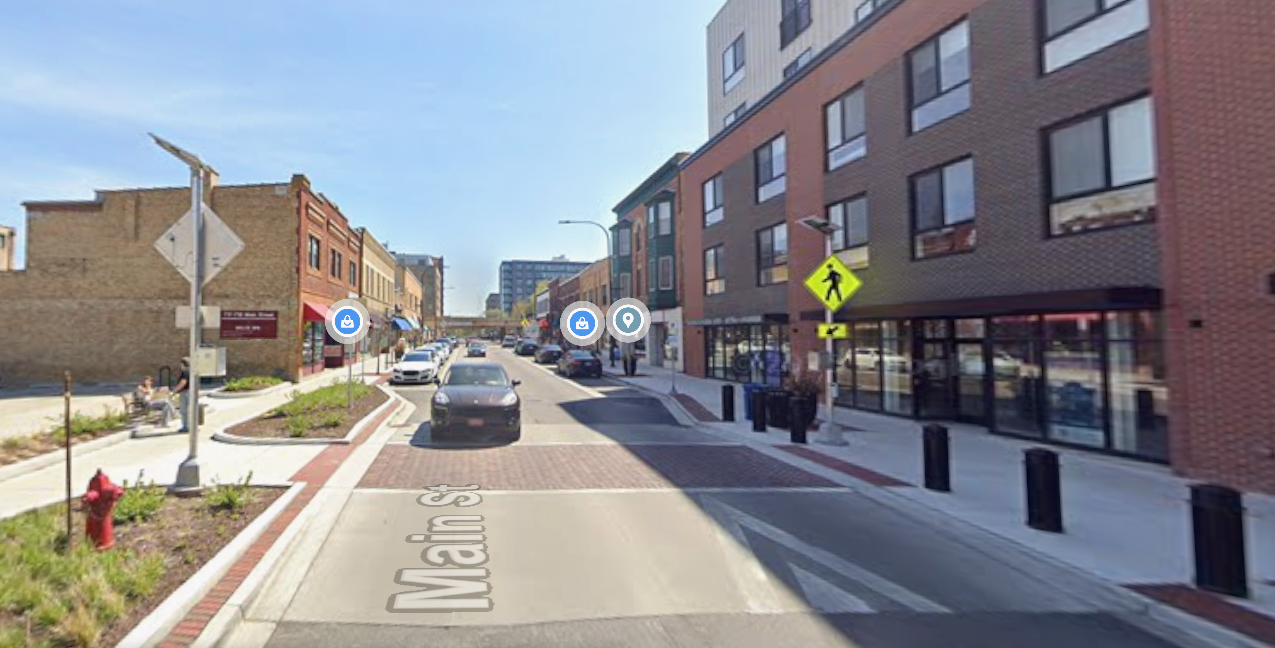
Evanston installed a raised crosswalk on Main St near Sherman Ave. Taking a trip to see this raised pedestrian infrastructure in use can be helpful for visualizing what a raised intersection would look like, as it’s essentially the same concept only slightly larger.
Evanston’s raised crosswalk has noticeably improved pedestrian safety, and has had no maintenance or drainage/snow plow issues.
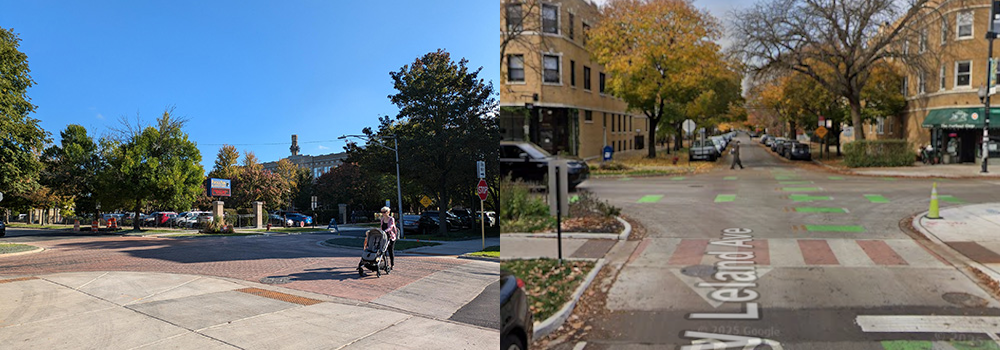
Chicago has installed many protected intersections, including those pictured below in the Portage Park neighborhood at Berteau and Long Ave in front of an elementary school and in the Ravenwood neighborhood at Damen and Leland, which sees significant traffic for cars, bikes, and pedestrians.
Is there evidence that raised pedestrian infrastructure is safer and more effective than traditional crosswalks?
Research confirms that raised pedestrian infrastructure are highly effective at reducing vehicle speeds and significantly lowering the frequency and severity of crashes involving vulnerable road users. Potential drawbacks listed are manageable through optimized geometric designs—such as specific ramp slopes and platform heights—that balance safety benefits with operational efficiency, or do not apply in the context as proposed (ie-no bus route, etc).
